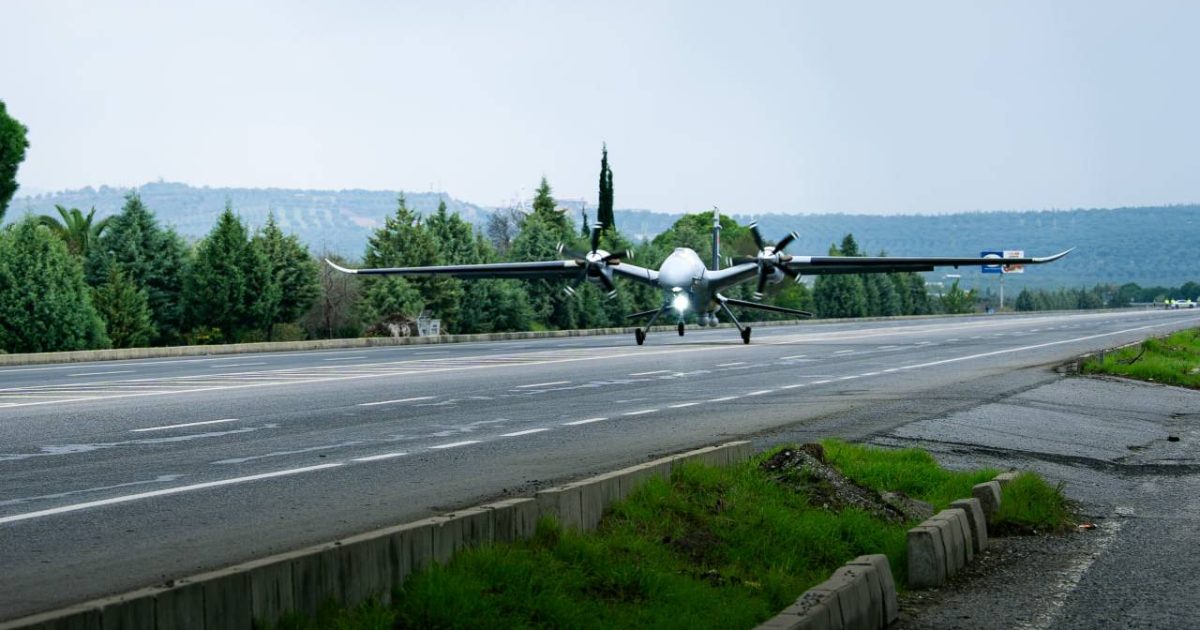
As part of ongoing efforts for emergency scenarios where conventional runways become unusable, Bayraktar AKINCI and Bayraktar TB2 armed unmanned aerial vehicles (UCAVs) successfully executed takeoffs and landings on the Manisa–Balıkesir Highway. Sending a clear message in modern warfare doctrine that “air power will not stop even if airports are hit,” this historic drill opened a new chapter in Türkiye’s defense capabilities.
The first field application of initiatives launched to ensure that unmanned aerial vehicles (UAVs/UCAVs), developed indigenously and originally by Baykar, can operate uninterruptedly under extraordinary conditions where fixed runways cannot be used has been successfully completed. During the emergency response drill conducted on November 12 in coordination with the Ministry of National Defense (MSB), the General Directorate of Highways (KGM), and Baykar, the national platforms used the highway as a runway.
Taking Off from Different Bases to Meet on the Same Highway
In the exercise carried out following technical inspections and designated routes across different parts of Türkiye, national aircraft taking off from three separate bases landed at the exact same location. A Bayraktar TB2 used by Baykar for training and testing that took off from Keşan, a Bayraktar AKINCI taking off from Çorlu, and another Bayraktar TB2 from the Land Forces Command inventory taking off from İzmir smoothly completed landings and takeoffs on the Manisa–Balıkesir Highway.
Throughout the drill, the Manisa Governor’s Office, Provincial Gendarmerie Command, and Provincial Security Directorate implemented extensive security measures along the route, while firefighting and ambulance teams were kept on standby. The operation was also observed on-site by teams from the force commands of the Turkish Armed Forces (TSK), the General Directorate of Security, the Gendarmerie General Command, and the Coast Guard Command. The newly established operational concept is planned to be expanded in the upcoming period to cover all platforms developed by Baykar, including Türkiye’s first unmanned fighter aircraft, Bayraktar KIZILELMA, and Bayraktar TB3, which is capable of taking off and landing on short-runway ships.
Targeting Airports No Longer Makes a Difference
This landing and takeoff operation on the Manisa–Balıkesir Highway goes far beyond an ordinary aviation test, serving as a direct strategic message and a deterrence move aimed at modern warfare doctrine. In traditional and modern conflict scenarios—as seen in recent regional wars—an attacking force’s primary objective is always to ground the adversary’s air power by striking its airbases, radars, and runways with ballistic missiles or kamikaze drones.
With this exercise, Türkiye sent an unmistakable message to potential threats that hitting or disabling airports and fixed runways will no longer yield a decisive outcome on the battlefield. Even if stationary airbases are targeted, Türkiye’s network of thousands of kilometers of divided highways spanning the entire country now possesses the capacity to transform into logistics, munitions-loading, and operational bases within a matter of hours during a crisis. Through this concept—known in military literature as “distributed operations”—aircraft are prevented from concentrating in a single hub and becoming easy targets, maximizing the survivability of units and their ability to conduct uninterrupted operations.
A New Force Multiplier for Global Export Leadership
This doctrinal shift demonstrated in the field directly boosts the competitiveness of the Turkish defense industry in the global market. Operating all its projects entirely with its own equity, Baykar sits at the top of the global UCAV market, having signed export agreements with a total of 40 countries—37 for Bayraktar TB2 and 16 for AKINCI. Generating 90 percent of its revenues from exports and serving as the locomotive of Türkiye’s high-technology exports with an export volume of $2.2 billion in 2025, the company has widened the technological gap with its global competitors one step further by equipping its platforms with this “runway-independent operation” capability.